Blog · 12/08/2026
AI Interpreter or Human: Will the Simultaneous Interpreter Become Obsolete?
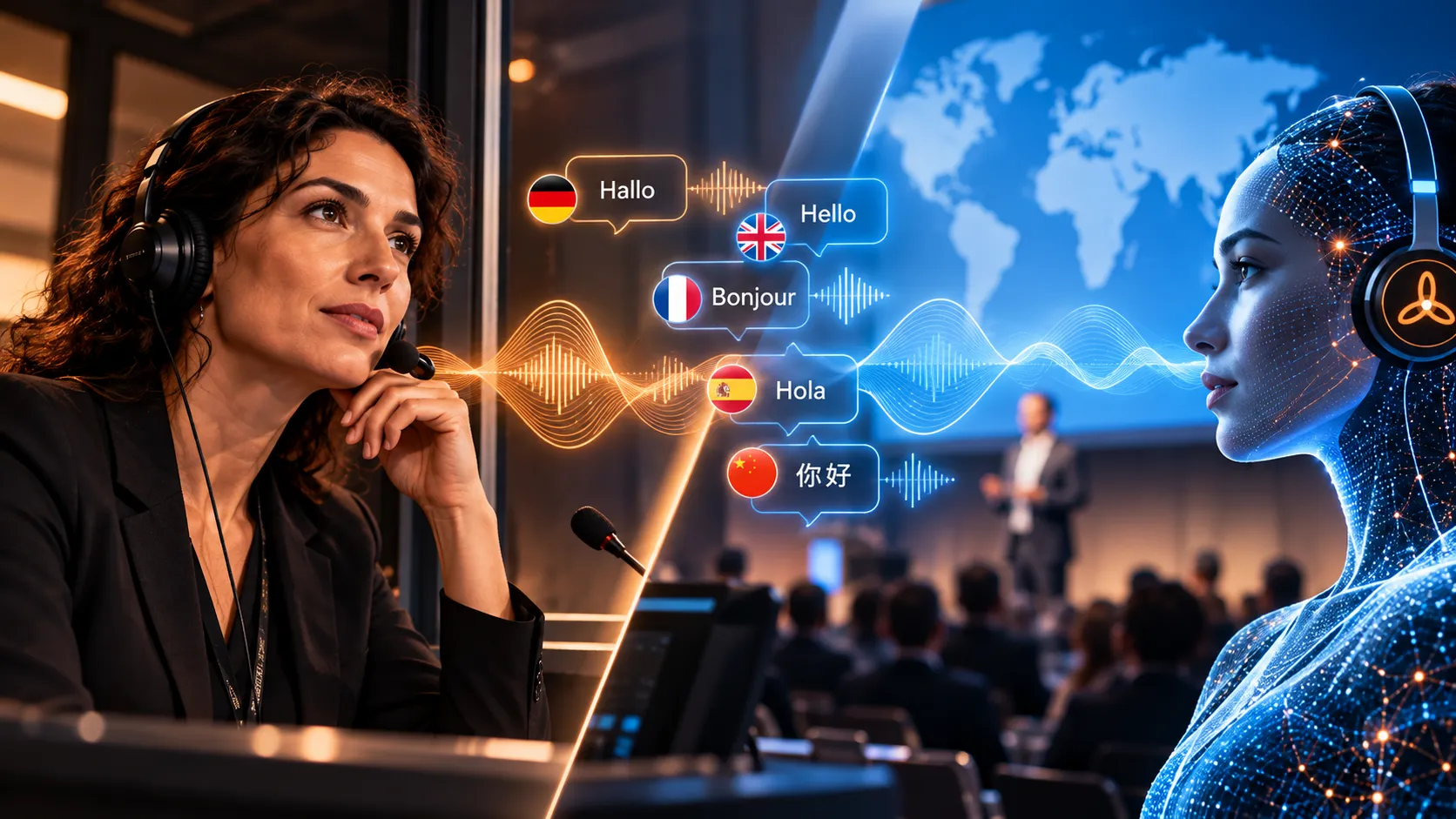
Booths, audio equipment and trained interpreters: for decades, this is what professional language mediation at international conferences looked like. Today, AI interpreters are taking over part of this task. They recognise spoken language, translate it and reproduce it as a synthetic voice. For event organisers, agencies, companies and associations, this raises an obvious question: will the human simultaneous interpreter soon become redundant? The answer is more nuanced than a simple yes or no.
An industry in transition
International conferences, corporate events and specialist congresses depend on professional language mediation. Anyone inviting guests from several countries wants everyone to be able to follow the programme – regardless of the language spoken on stage.
For a long time, the established standard for this was clear: classic simultaneous interpreting with conference interpreters, booths and the appropriate audio equipment.
AI-based language systems are noticeably changing this situation – both technically and economically. What seemed experimental just a few years ago can now be used in practice under suitable conditions. This broadens the range of options organisers can consider for multilingual formats.
What human simultaneous interpreters deliver
To answer the question about the future fairly, it is worth taking a close look at the work of interpreters. Professional interpreting is far more than transferring individual words.
An experienced interpreter:
- recognises connections beyond individual sentences,
- interprets cultural particularities,
- takes the speaker's intention into account,
- resolves ambiguities,
- responds to unexpected situations and
- adapts their interpretation to the particular conversational situation.
This becomes especially demanding with emotional speeches, negotiations, political debates or complex technical discussions. In such situations, it is not only about the content, but also about nuance, attitude and impact. This is where human judgement plays a decisive role.
Where AI interpreters play to their strengths
AI-based interpreting systems come in at a different point. Their strengths lie less in interpreting subtle nuances than in continuity, scalability and organisation.
They can:
- continuously process large volumes of speech,
- provide several language channels in parallel and
- reduce the organisational effort involved in multilingual events.
Which formats AI interpreting is suited to
The technology is particularly interesting for events with a clear structure and an informative character, such as:
- standardised conference formats,
- product presentations,
- training sessions and
- international corporate events.
There is also an aspect that is new for many organisers: AI interpreting opens up possibilities for events where classic simultaneous interpreting has so far not been economically feasible. Formats that previously had to remain monolingual can become multilingual for the first time. You can find an overview of typical formats in our areas of application.
Human or machine? The real change
The debate is often framed as either-or. A more realistic picture looks different: the future of simultaneous interpreting will probably be neither exclusively human nor exclusively artificial. Instead, different models of language mediation are emerging, each suited to particular requirements.
- Sensitive conversations: For negotiations, political discussions or emotionally charged speeches, human interpreters remain important.
- Standardised information events: For product presentations, training sessions or clearly structured conference programmes, AI systems can be a practical alternative.
- Hybrid concepts: Approaches that combine both routes are also conceivable.
So the real change is not that a profession is disappearing. It is that organisers now have more options – and can decide more deliberately which form of language mediation suits their format.
Which interpreter is right for your event?
From the strengths described, a few guiding questions can be derived to help with planning:
What is the character of the event? Is the focus on conveying information, or is it about negotiation, discussion and nuance?
How many languages are needed? The more language channels are required, the more the organisational effort comes into play.
How sensitive is the content? With confidential topics, besides the interpretation itself, the question of where the spoken content is processed also matters.
What equipment is available on site? Is there already an interpretation system or conference equipment to which a solution can be connected?
Anyone who clarifies these questions early will find the right solution more easily – whether conference interpreters in the booth, AI interpreters or a combination.
The MILA perspective
At MILA, we do not see AI interpreting as a blanket replacement for human expertise. Our aim is to make professional language interpreting for events technically more accessible.
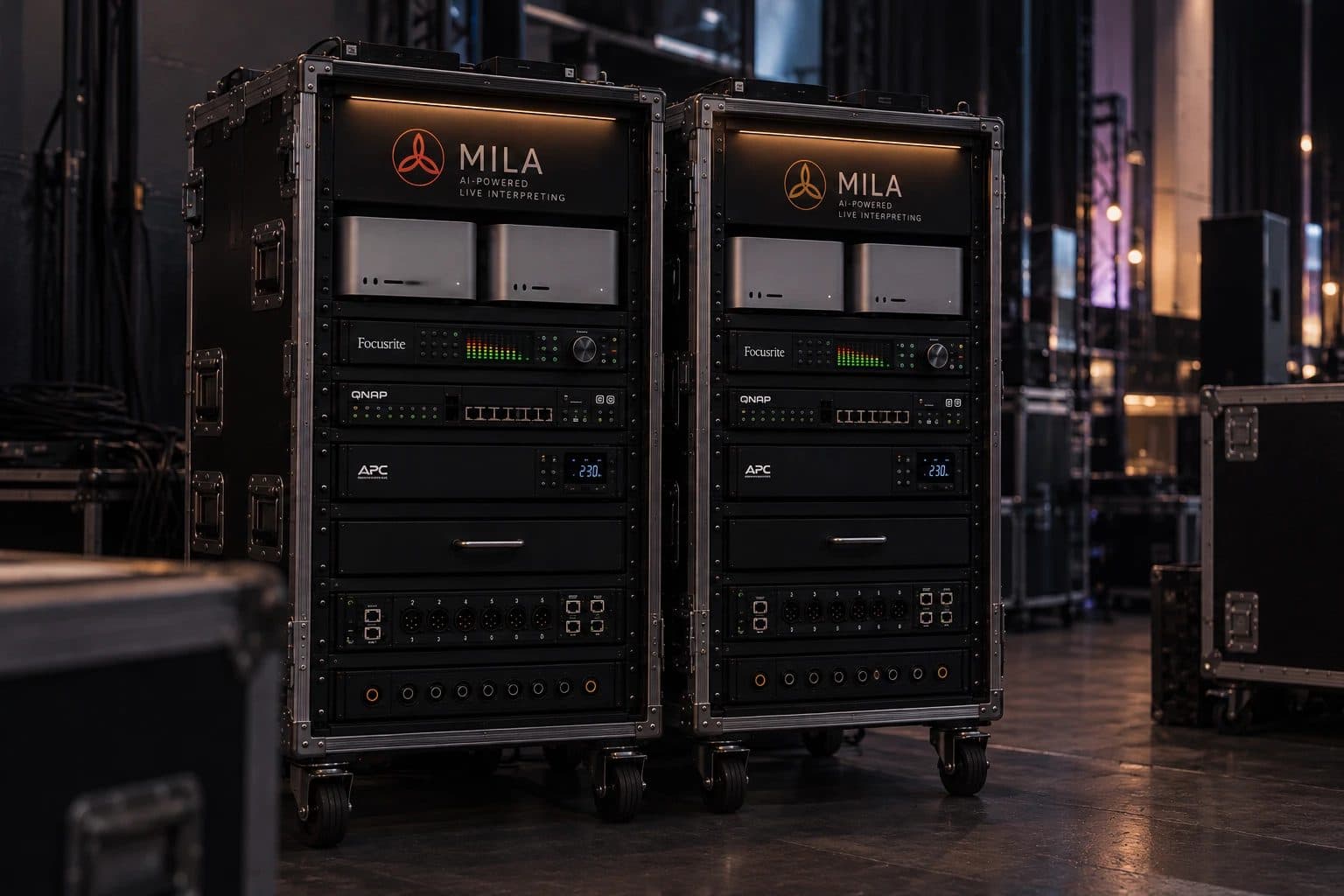
To do this, we combine local AI processing with professional audio equipment and an operating concept designed for live events. In concrete terms, this means:
- Local instead of cloud: The AI simultaneous interpreting runs on our own equipment at the venue. Spoken content does not leave the event.
- Service instead of software: Equipment, set-up and support come from us. A system technician is always on site – they plan with you, set up, look after the interpreting during the event and dismantle afterwards.
- Language preparation: We set up technical terms and proper names from your programme in advance.
- Connection to existing equipment: Each language is fed into your interpretation system or conference equipment on its own channel. On request, we provide receivers and headphones for the guests.
- Languages: German, English, French, Spanish, Italian, Dutch and Polish are available; further languages on request.
You can find out which components are included in the service package and what can be added, such as further target languages, additional days or set-up with a rehearsal the day before, on our services page.
Conclusion: the requirements decide
Will human interpreters become redundant? No – at least not across the board. For sensitive conversations, negotiations and emotional speeches, human judgement remains in demand. For standardised information formats, AI interpreters offer a practical alternative and make some multilingual events possible in the first place.
What matters is not whether an interpretation comes from a human or a machine. What matters is whether the chosen solution meets the requirements of the event.
Are you planning a congress, a conference or a corporate event and would like to know whether AI interpreting suits your format? You can find answers to frequently asked questions in our FAQ – or get in touch with us directly.