Blog · 26/10/2026
AI Interpreting and Audio Technology: Why Everything Starts at the Microphone
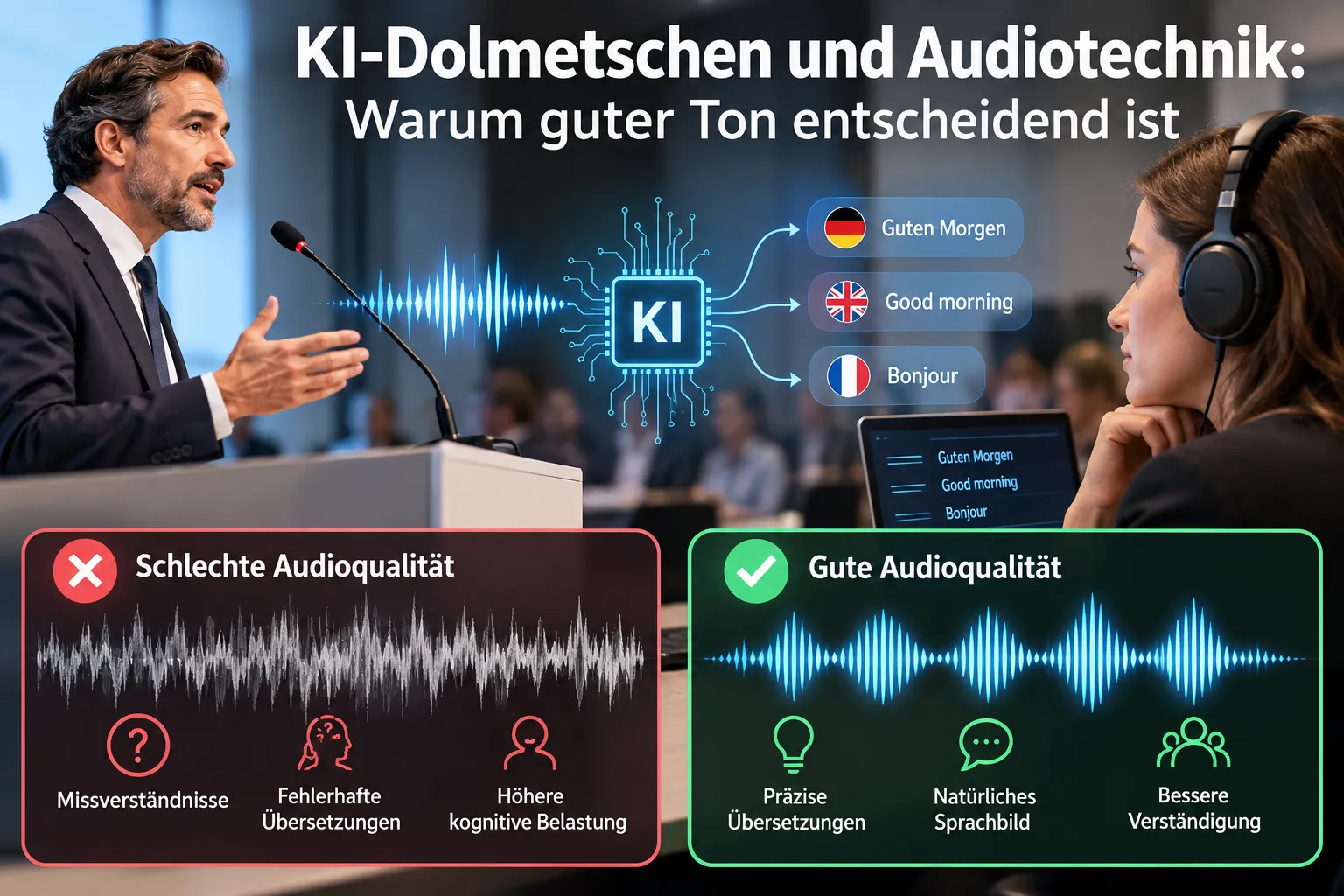
When people talk about AI interpreting, the conversation usually centres on language models, computing power and translation quality. One factor is easily overlooked, even though it comes at the start of every translation: the input signal. Even a powerful language model can only translate what it understands. Information that has already been lost during capture cannot be reliably reconstructed later. Anyone planning simultaneous interpreting for a congress, a specialist conference or a corporate event should therefore not treat the interplay between AI interpreting and audio technology as a minor detail. In this article, we show why good sound is the foundation of every reliable translation – and what you can look out for when planning.
The best AI can only translate what it understands
In the hall, sound often seems a given: the speaker talks, the loudspeaker carries the voice, the audience listens. Human listeners unconsciously compensate for a great deal – a brief burst of noise, a little reverberation, a quiet start to a sentence. For an AI interpreting system, by contrast, the signal is the only source of information.
Typical sources of interference that can significantly impair automatic speech recognition include:
- poor microphone placement, such as a microphone that is too far away or incorrectly positioned,
- room reverberation, which blurs syllables and makes word boundaries indistinct,
- background noise from the hall, ventilation systems or the foyer,
- overdriven signals, in which parts of the speech are distorted.
What is lost at this moment cannot be recovered by any downstream processing.
How audio quality affects simultaneous interpreting
To understand why sound matters so much, it is worth looking at the processing sequence. An AI interpreting system first processes acoustic information. From this, it has to recognise words, sentence boundaries and linguistic context. Only on this basis is the translation produced.
If the input signal is impaired, errors can already occur during speech recognition. These errors may carry over into the translation – because the system translates what it has recognised, not what was meant.
A single word can change the sentence
This becomes particularly clear with technical terms. A misrecognised technical term can give an entire sentence a different meaning. At a specialist conference, where precise terminology carries the content, this is more than a cosmetic flaw.
At MILA, we therefore set up technical terms and proper names from the programme in advance. This preparation is an important building block – but it only takes effect if the word can also be heard clearly in the signal. Language preparation and audio technology go hand in hand.
Microphone placement is no minor matter
For professional events, basic rules of audio engineering therefore apply, and they become even more important for simultaneous interpreting.
Direct signal rather than room sound: A signal taken as directly as possible from the microphone – for example from the lectern, a handheld microphone or a headset – is often better suited than a signal captured via room microphones. Besides the voice, room microphones also pick up reverberation and noise from the hall.
Sufficient signal-to-noise ratio: The voice should stand out clearly from the noise floor and ambient sounds.
Controlled levels: Signals that are too quiet get lost in the noise; signals that are too loud become overdriven. Both make recognition more difficult.
Clean separation of audio sources: Wherever possible, speech, music, video playback and hall noise should not reach the system via the same path.
Special case: panel discussions
Panel discussions are particularly demanding. Multiple speakers, interjections and changing microphones place high demands on sound management. Who is speaking right now? Is the right microphone open? Is an interjection even included in the signal? For formats like these in particular, it pays to plan the microphone set-up together at an early stage.
Digital audio networks as a foundation
In professional event environments, audio signals are increasingly transmitted via digital networks. Technologies such as Dante make it possible to distribute numerous audio channels over a network infrastructure – instead of cabling each connection individually.
This opens up interesting integration options for AI interpreting systems:
- Input signals can be taken directly from existing mixing desks.
- Translated language channels can be fed back into the audio environment.
For this to work during live operation, routing, synchronisation, network stability and redundancy must be taken into account. A channel that is incorrectly routed or briefly drops out has a direct impact on the translation.
Regardless of the transmission path, the following applies at MILA: each language is delivered on its own channel into the existing interpretation system or conference technology. On request, we also provide receivers and headphones for guests. You can find out which technology is used for this on our page on services and interpreting technology.
Why monitoring is indispensable
AI interpreting must not be operated as a black box. During an event, it must be possible at all times to see whether the interpreting chain is working as it should.
Professional systems therefore need ways to monitor:
- input levels,
- output signals,
- system load and
- processing delays.
The decisive factor here is fault isolation. Technicians must be able to tell whether a problem is caused by the audio feed, the network or the AI processing. Only then is it possible to respond in a targeted way during a live event, rather than searching in several places at once on the basis of guesswork.
AI interpreting and audio technology: what you should clarify in advance
From these relationships, a number of questions can be derived that will help when planning an interpreter for your event:
How will the speakers be miked? Are there lectern, handheld or headset microphones – or will sound be captured via room microphones?
Are there formats with multiple speakers? Panel discussions, audience Q&A sessions or on-stage interviews require their own planning.
What technology is available on site? Is there a mixing desk, an interpretation system, conference technology or a digital audio network that can be connected to?
How will the languages reach the guests? Via an existing system or via additional receivers and headphones?
Is a rehearsal possible? Setting up with a rehearsal the day before provides an opportunity to check signal paths and levels under real conditions.
Clarifying these points early creates the conditions for stable simultaneous interpreting – at congresses and conferences as well as at corporate events or public meetings. You can find an overview of typical formats in our areas of application.
The MILA perspective: audio as part of the interpreting chain
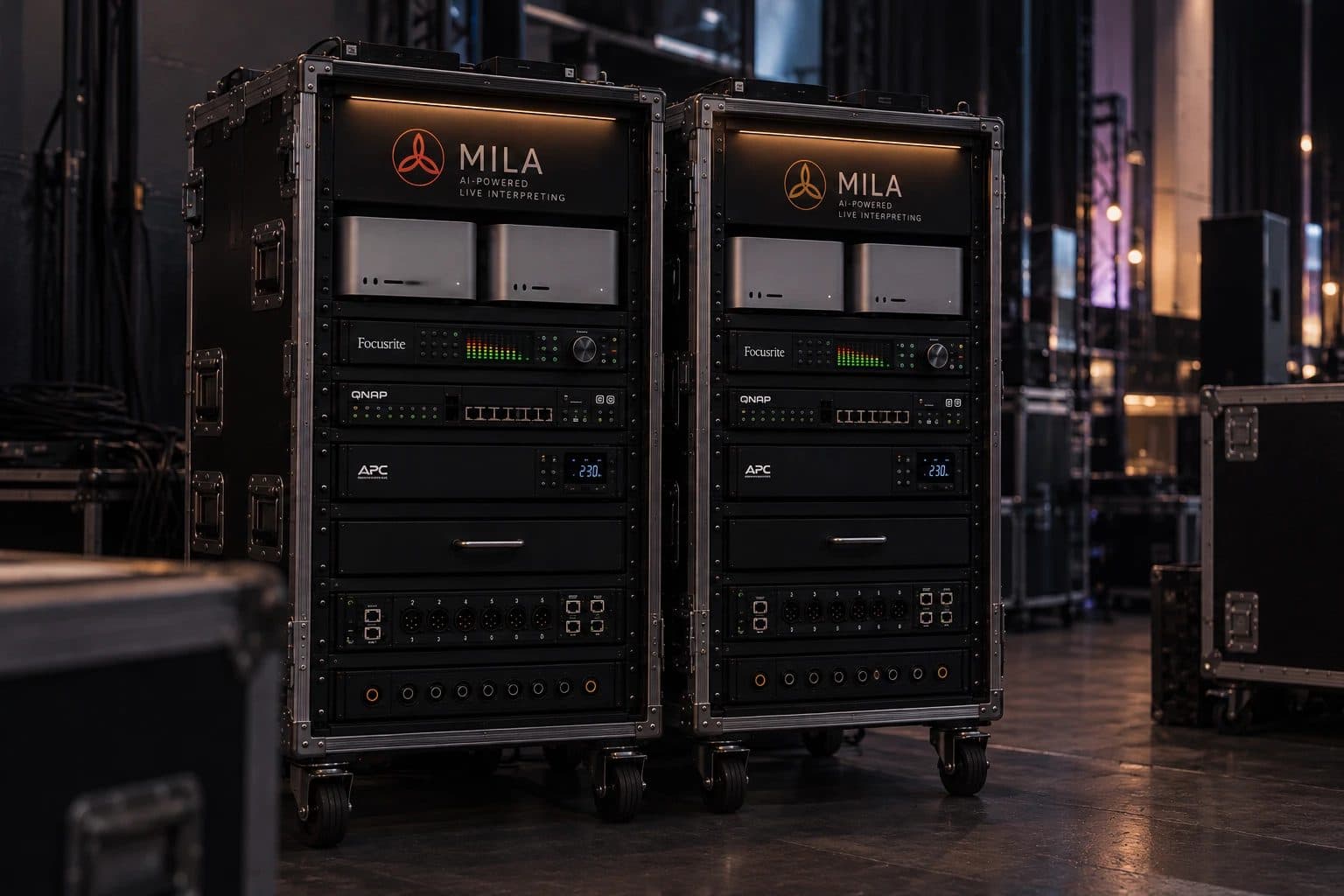
MILA was designed as a system for professional event environments. That is why we regard audio integration not as an accessory but as an integral part of the entire interpreting chain. Local computing power, professional signal routing and technical monitoring must work together.
In practice, this means:
- Local rather than cloud: AI simultaneous interpreting runs on our own equipment at the venue. What is said does not leave the event.
- System technician on site: A system technician plans with you, sets up, looks after the interpreting during the event and dismantles everything afterwards.
- Prepared languages: We set up technical terms and proper names from the programme in advance.
- Connection to your technology: Each language is delivered on its own channel into the existing interpretation system or conference technology.
How AI interpreting fundamentally differs from traditional conference interpreters in the booth, and which formats it is suited to, is something we examine in the article AI interpreter or human.
Conclusion: reliable interpreting begins at the microphone
The discussion about AI interpreting often revolves around the language model. For practical use at events, what happens before that is at least as important: how the voice is captured, how the signal is routed and how the chain is monitored. Reliable AI interpreting does not begin with the language model. It begins at the microphone.
Are you planning a multilingual event and would like to know how interpreting will fit into your existing sound and conference technology? Get in touch – we will be happy to clarify the audio situation together with you and your technical team. You can also find answers to further questions in our FAQ.