Blog · 10/08/2026
Can AI Tell Voices Apart? Speaker Recognition and Voice Cloning Explained
Who is speaking right now? In a classic presentation, this question hardly arises: one person speaks, the audience listens. On a panel, things look different. Several people take turns, interrupt one another or speak at the same time. For AI-assisted simultaneous interpreting, this creates an additional task: the system must not only understand what is being said, but ideally also recognise who is speaking. That is exactly what speaker recognition is about. In this article, we explain how speaker diarization works, why overlapping speech is so challenging, what voice cloning could mean for interpreting – and what responsibility comes with replicating human voices.
From presentation to panel: why the question “Who is speaking?” matters
Whether human or AI: for any interpreting, the format makes a big difference. For a keynote at a congress or a presentation at a corporate event, there is one clear source: the microphone at the lectern or the headset of the person on stage. Who is speaking is unambiguous.
In a panel discussion, this changes. The moderator asks a question, one guest answers, a second disagrees, a third adds something mid-sentence. Such exchanges are intended; they make a discussion lively. For an AI system, however, they mean that two tasks have to be solved at once:
- What is being said? This is the basis of any interpreting.
- Who is saying it? This information helps to keep contributions apart and make connections easy to follow.
Anyone following a discussion through interpreting relies on changes between speakers remaining recognisable. Otherwise, statement and response quickly blur into a single stream.
AI speaker recognition: what speaker diarization does
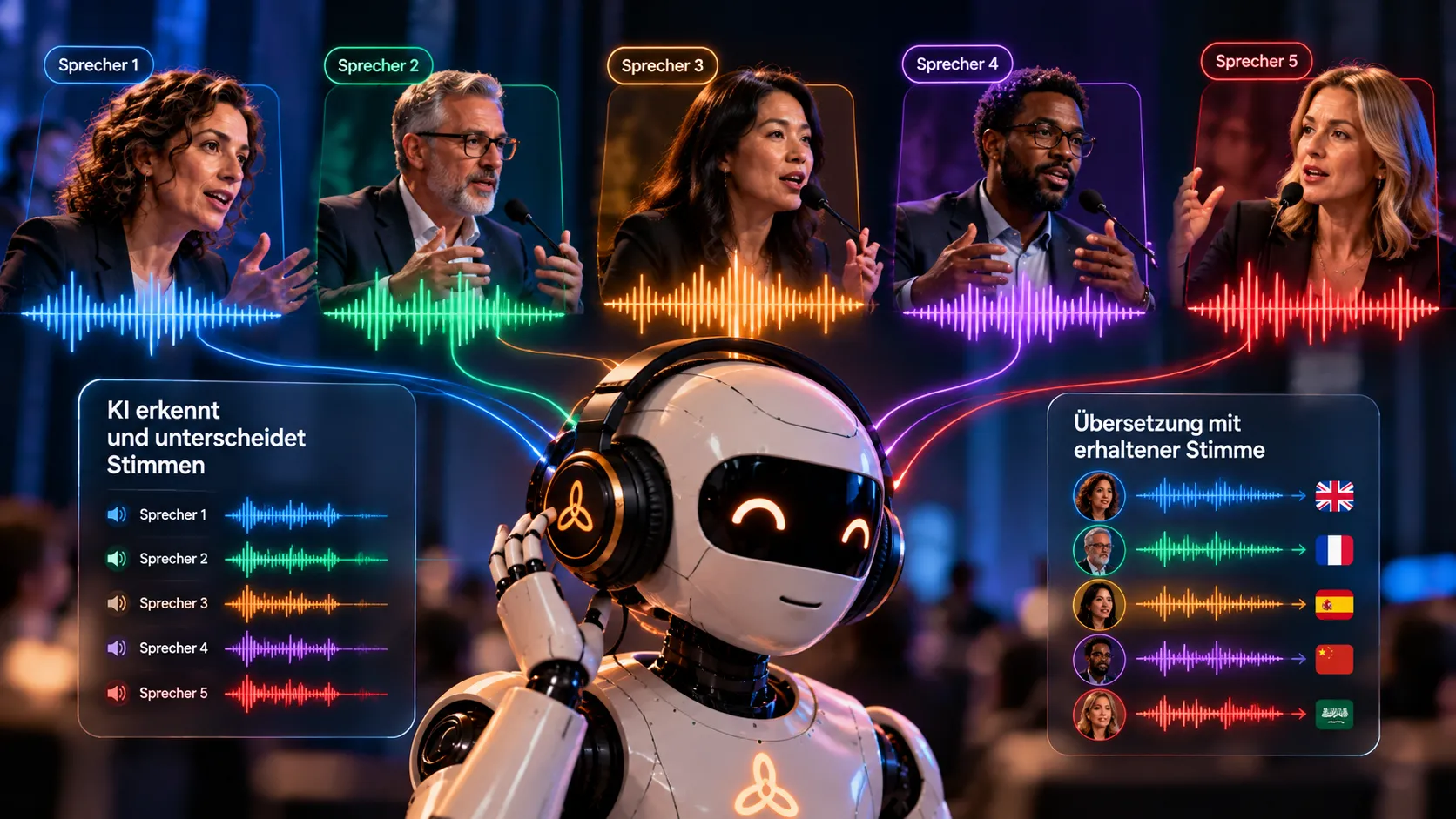
The technical term for assigning segments of speech over time to different speakers is speaker diarization. Such a system analyses acoustic properties of the signal and tries to distinguish different voices from one another.
The result is a structure over time. In simplified form, it might look like this:
- Speaker A speaks in the first segment,
- Speaker B takes over,
- Speaker C comes in,
- then Speaker A speaks again.
One point is often overlooked here: speaker diarization is not the same as identifying people. The system does not necessarily need to know which real people are behind the voices. It is enough for it to recognise voice A and voice B as different voices. Whether A is the moderator and B the executive board member initially remains open for this task.
For simultaneous interpreting, it is precisely this capability that matters. Even the information that a different person is now speaking than before can help to render a discussion more comprehensibly.
When everyone talks at once: separating speakers in overlapping speech
Things get particularly difficult when several people speak at the same time. In a lively panel discussion, this happens regularly – a brief interjection, a word of agreement, two answers that overlap.
This is where audio source separation methods come into play. They are designed to separate different speech signals that overlap. In the best case, a mixture is turned back into individual, intelligible voices.
However, the quality of such methods depends heavily on the source material and the acoustic conditions. The more clearly the individual voices are contained in the signal, the better they can be told apart. What has already been lost in the sound cannot be reliably recovered, even by sophisticated separation.
What this means for your planning
For organisers, this means: the question of how well an AI can distinguish speakers is always also a question of audio engineering. We have described in detail how microphone set-up on panels lays the foundation for any interpreting in our article AI interpreting and audio technology: why everything starts at the microphone. If you are planning simultaneous interpreting for a panel discussion, it is worth coordinating the sound together at an early stage.
Voice cloning: can interpreting preserve the voice?
A second field of research goes one step further. It deals with the synthetic replication of human voices, often referred to as voice cloning.
Modern speech synthesis can adopt certain characteristics of a voice and use them for new spoken content. This opens up new possibilities for interpreting: a speaker could be rendered in another language while characteristic features of their voice are partly preserved.
The word “partly” is chosen deliberately. The aim is not to copy a person completely, but for the interpreting to no longer sound like a stranger’s voice, instead carrying features of the original.
Combined with speaker recognition, the potential becomes clear: if a system recognises that Speaker B is currently speaking and preserves their voice characteristics in the target language, an interpreted panel discussion could be considerably easier to follow. Similar questions arise when conveying emphasis and expression – read more in our article Can AI translate emotions?
Technical possibilities and ethical questions
As exciting as the technology is, replicating human voices brings considerable responsibility. A voice is something very personal. Anyone who generates it synthetically is operating in a sensitive area.
In our view, three prerequisites are key:
- Consent: The person whose voice is replicated must agree to it.
- Transparency: Particularly in a professional setting, it must be clear when a synthetic voice is being used. The audience should know that they are hearing interpreting and not the person themselves.
- Protection against misuse: Replicated voices must not be used outside the agreed purpose.
For companies, associations and public institutions, these questions are not abstract. At an annual general meeting, a specialist conference or a public session, it must be clear at all times who said what – and in what form it is being rendered.
MILA’s perspective on speaker recognition and voice preservation
For future AI interpreting systems, speaker recognition and voice preservation are important areas of development. Particularly in panel discussions, reliably assigning contributions to individual speakers could improve comprehensibility. We are therefore following these technologies closely.
Our yardstick remains the same: technical innovation must create real added value for communication. For us, a new feature only makes sense once it helps your guests follow an event better.
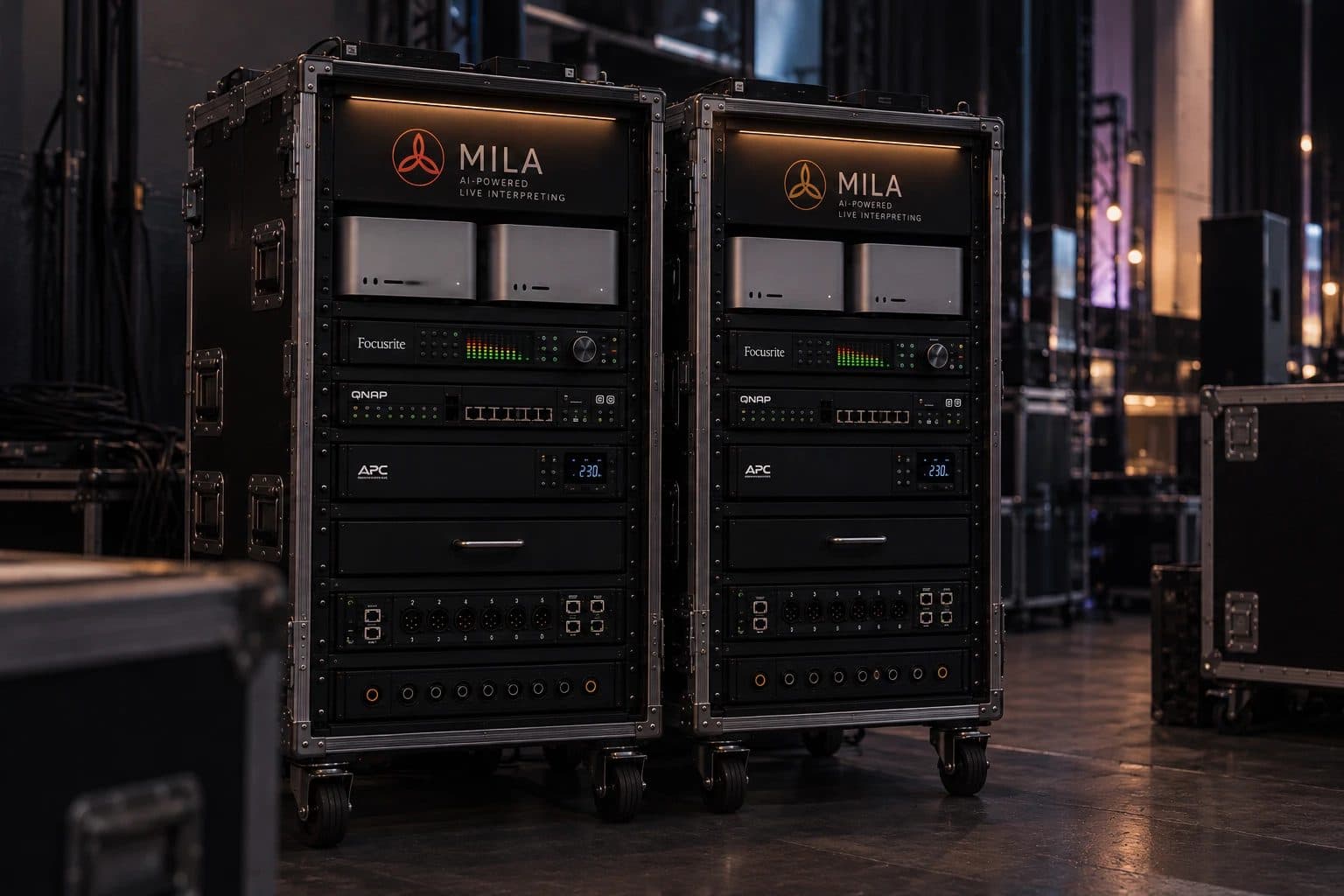
At your event, we currently rely on what can be planned reliably. The AI simultaneous interpreting runs locally on our own equipment at the venue, without the cloud – nothing that is spoken leaves the event. We set up technical terms and proper names from the programme in advance. Each language is fed on its own channel into the existing interpretation system or conference technology, with receivers and headphones for guests on request. And a system technician is always on site: they plan with you, set up, oversee the interpreting during the event and dismantle everything afterwards.
Are you planning a congress, a conference or a corporate event with a panel discussion and would like to know how interpreting can be implemented for it? You will find all the details on technology and process on our Services page. Our Areas of use show which formats we support – feel free to get in touch.