Blog · 16/10/2026
The cloud is not the only option: why local AI is making a comeback

Does powerful AI always have to come from the cloud? For many applications, the answer seems to have been settled long ago: data is sent to a large data centre, the processing happens there, and the result comes back. At the same time, however, an alternative is gaining ground that seems old-fashioned at first glance yet is technically highly topical: local AI. Anyone planning simultaneous interpreting for a conference, a congress or a corporate event should know what lies behind this approach – and where its limits are. In this article, we explain what local AI means, what advantages it offers at live events and why we at MILA have chosen this path.
How AI from the cloud works
Many AI applications are based on central data centres. The principle is simple: users send data to external servers, the processing takes place there, and the results are then transmitted back.
This model has its merits. It provides access to large computing capacities without having to operate the appropriate hardware yourself. At the same time, it creates dependencies:
- Connection: A stable internet connection is often a prerequisite. If it fails or fluctuates, the application is affected too.
- Data processing: It must be clear where and how the transmitted data is processed.
- Availability: Whether the service can be reached at the crucial moment is not entirely in your own hands.
- Control: The technical environment in which the processing takes place is designed by an external provider.
For many everyday applications, these points are acceptable. For time-critical applications that have to work live, the equation looks different.
What does local AI mean?
With local AI, the models run directly on your own hardware – not in a remote data centre. Processing takes place, for example, on workstations, on specialised computers or on compact systems.
Two terms are commonly used for this approach:
- On-premise AI emphasises that the AI is operated “on site”, i.e. within your own technical environment.
- Edge AI describes processing at the “edge” of the network – where the data is generated, rather than in a central cloud.
In both cases, the same basic principle is meant: data is processed where it arises. Especially when results are needed at the very same moment, this can make a decisive difference.
Local AI at live events: what organisers gain
A live event illustrates well why this matters. A speech is not repeated because the interpreting dropped out for a moment. Whatever is not transmitted at that instant is lost to the audience.
Less dependent on the internet connection
At an international conference, language interpreting should ideally not depend on a fluctuating internet connection. Anyone who has ever supported an event at a busy venue knows the situation: many devices share the same network, and the connection is not always as stable as it should be.
Local systems can reduce this dependency. If speech processing runs on hardware at the venue, the spoken word does not first have to travel to a data centre and back before the interpretation reaches the audience.
Confidential content in a controlled environment
The second advantage concerns how what is said is handled. With local AI, even confidential discussions can be processed within a controlled technical environment. For companies, associations and public institutions, this can be an important argument – for example at corporate events or meetings where content is discussed that should not leave the room.
Local does not automatically mean GDPR-compliant
When it comes to AI interpreters and data protection in particular, some context is important: a local system is not automatically completely secure or GDPR-compliant. Data protection also depends on technical safeguards, organisational processes and the specific data processing involved.
Local processing therefore creates a good starting point, but it does not replace careful clarification in each individual case. Anyone planning an event with sensitive content should discuss these questions with the service provider at an early stage.
The technical price of independence
Local processing does, however, place high demands on the technology. What a large data centre handles in the cloud has to be managed by the on-site hardware with local processing.
Language models require memory, computing power and efficient processing. It becomes particularly demanding when several languages are to be processed simultaneously in real time – which is exactly what a multilingual conference requires.
This is why three areas of development are particularly relevant for local AI:
- Model compression: Models are reduced in size so that they need fewer resources while losing as little performance as possible.
- Quantisation: A model’s internal numerical values are stored at lower precision. This reduces memory requirements and speeds up computation.
- Specialised hardware: Computers designed for AI computations make on-site processing easier.
The MILA perspective: simultaneous interpreting without the cloud
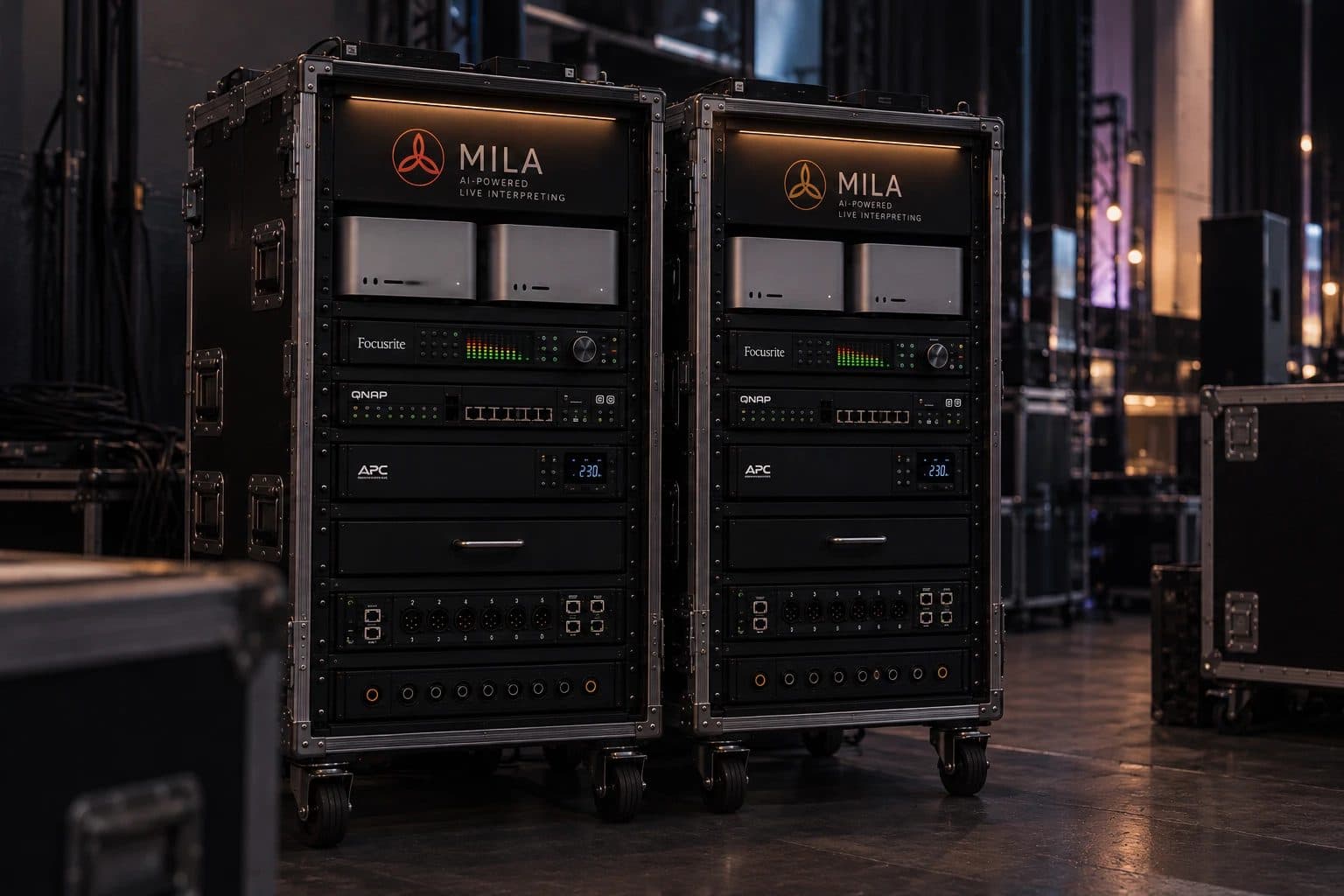
MILA follows a local architectural approach. Our AI simultaneous interpreting runs on our own equipment directly at the venue – without the cloud. What is spoken does not leave the event.
This allows us to control the technical environment and avoid dependence on cloud-based speech processing. For you as an organiser, this means that the interpreting does not rely on an external service being available at the crucial moment.
Anyone looking for an interpreter for events usually does not need software they have to operate themselves, but a service. That is why, for us, local AI is part of a complete package:
- System technician on site: A system technician plans with you, sets up, looks after the interpreting during the event and dismantles everything afterwards.
- Dedicated channels: Each language is fed into the existing interpretation system or conference equipment on its own channel. On request, we provide receivers and headphones for the audience.
- Language preparation: We set up technical terms and proper names from the programme in advance.
Incidentally, the input signal is just as important as computing power. You can read why good microphone setup is the foundation of any interpreting in our article AI interpreting and audio technology: why everything starts at the microphone.
Not a step backwards, but a question of architecture
For us, local AI is not a nostalgic return to having your own server. It is a deliberate architectural decision for professional real-time applications – and a live event with international guests is exactly such an application.
The cloud remains useful for many purposes. But where availability, control over the technical environment and the handling of the spoken word matter, it is worth taking a look at the local alternative.
If you would like to know what locally operated simultaneous interpreting could look like for your conference, congress or corporate event, you will find all the details on equipment and procedure on our Services page. We have compiled answers to frequently asked questions in our interpreting FAQ – and for a specific project, we will be happy to talk to you directly.