Blog · 09/09/2026
Does AI understand what it translates? What an AI interpreter does with context
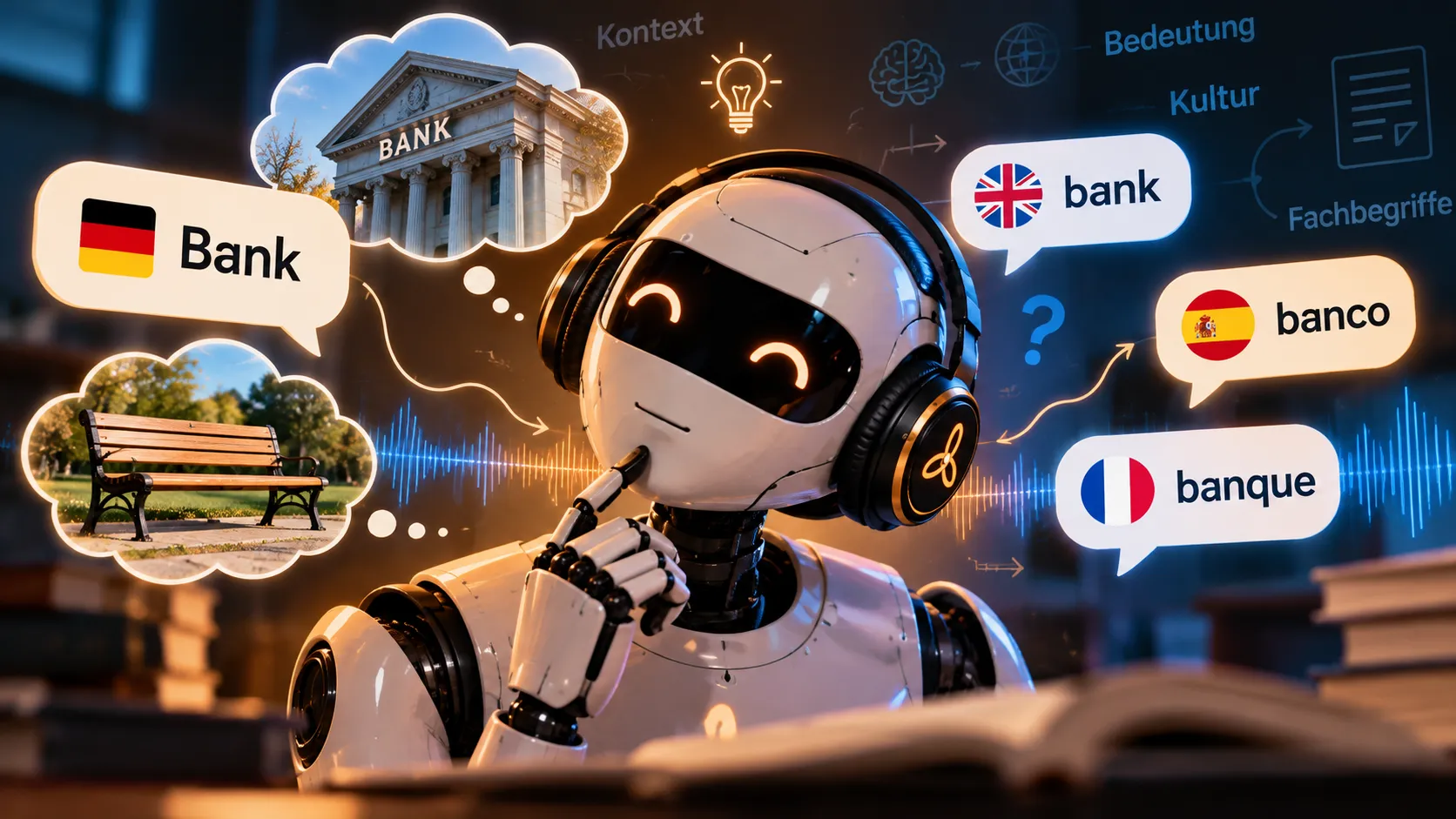
A speaker says, in German: “Danach gehen wir noch zur Bank” – “Afterwards, we’re going to the bank.” Which Bank does she mean? Anyone sitting in the room will usually know straight away. An AI interpreter, on the other hand, has to work this out from the context – while the speech carries on. This raises a question that matters for any simultaneous interpreting at congresses, conferences and corporate events: does AI actually understand what it translates? In this article, we explain how AI systems deal with context, ambiguity and technical terms, where their limits lie – and what ultimately matters when it comes to interpreting for events.
One simple word, several meanings
The German word “Bank” can refer to a financial institution or to a place to sit. For people, the meaning is usually obvious straight away within a conversation: someone talking about accounts and interest rates doesn’t mean the park bench. Someone describing a walk doesn’t mean the branch office.
For translation, this distinction is crucial. In English, for example, the financial institution becomes “bank”, while the seat becomes “bench”. Looking only at the individual word, it is impossible to determine the correct option. An AI system therefore has to infer the meaning from the surrounding sentence.
This example shows on a small scale what applies to all simultaneous interpreting: translation is more than swapping individual words. What is conveyed is meaning – and meaning only emerges in context.
How an AI interpreter processes context
Modern language models learn statistical relationships from large amounts of data. They capture which words, phrases and sentence structures typically occur together, and can therefore recognise complex patterns too. If “Bank” appears in a sentence alongside “account” and “transfer”, the picture is different from when it appears next to “park” and “rest”.
On this basis, the models relate pieces of linguistic information to one another. This produces remarkably powerful translations.
Recognising patterns or understanding language?
Whether these abilities are equivalent to human language comprehension, however, is a contested question, both scientifically and philosophically. A language model processes patterns and relationships – whether it “knows” what it is all about in the human sense cannot be answered definitively.
For event organisers, this fundamental question is usually less pressing than a practical one: does the content reach the audience correctly? How AI systems and human conference interpreters compare in this respect is something we discuss in the article AI interpreter or human: Will the simultaneous interpreter become obsolete?
Context changes meaning
It is not only individual words – entire sentences can also be ambiguous without their surroundings. A sentence such as “That didn’t work last time” is hard to interpret on its own: what is “that”, and when was “last time”? The answer lies in what was said before.
Only previous statements, specialist knowledge or the specific conversational situation make the meaning clear. People who follow a presentation from the beginning resolve such references as a matter of course.
For AI interpreting systems, the processing of a longer conversational history is therefore particularly interesting. The more of the preceding course of a presentation or discussion can feed into the translation, the more clues are available to place references correctly. Simultaneous interpreting adds a particular challenge: it is produced while the speech is still under way. Whatever the speaker clarifies only later is not yet available at the moment of translation.
Technical terms as a challenge at congresses and specialist conferences
The limits become particularly clear with specialist language. Technical conferences frequently use terms that rarely appear in general training data. The model has simply seen such words rarely, or never, in a suitable context.
Typical stumbling blocks include:
- product names that need to remain as proper names but may sound like ordinary words,
- abbreviations that are unambiguous within an industry but can mean something entirely different outside it,
- industry-specific phrases whose meaning cannot be derived from the individual words.
All of this can lead to errors. For interpreting at congresses and specialist conferences, this is no minor issue, because it is exactly there that precise terms carry the content.
What glossaries and terminology lists can achieve
Terminology lists and glossaries can help to account for such terms in a targeted way – provided the system in use supports these functions. At MILA, this preparation is a fixed part of the process: we set up technical terms and proper names from the programme in advance.
One limitation always applies, though: the system can only assign a term correctly if it can also be heard clearly in the audio signal. Why audio technology is therefore just as important as language preparation is something we describe in the article AI interpreting and audio technology: Why everything starts at the microphone.
Why convincing errors are dangerous
A faulty AI translation does not necessarily sound obviously wrong. Sometimes a system produces a grammatically flawless sentence that nevertheless alters the original content.
That is precisely where the risk lies. A clumsy translation stands out – listeners notice that something is not right. A fluent, natural-sounding sentence, on the other hand, is usually believed. Anyone who does not understand the original language has no way of checking it against what was said.
At professional events in particular, this type of error is problematic: when it comes to technical statements, figures or decisions, what counts is not how good a sentence sounds, but whether it is correct. A related danger, incidentally, concerns tone – when a system adds emotions that the speaker never intended to express. You can read more about this in the article Can AI translate emotions?
What this means for planning your event
The limits of the technology lead to some very practical conclusions if you are planning simultaneous interpreting for your conference, congress or corporate event:
- Share the programme and technical terms in advance: product names, abbreviations and the names of the speakers can only be set up if they are known before the event.
- Pay attention to the sound: a clear input signal is the prerequisite for context and technical terms to be recognised at all.
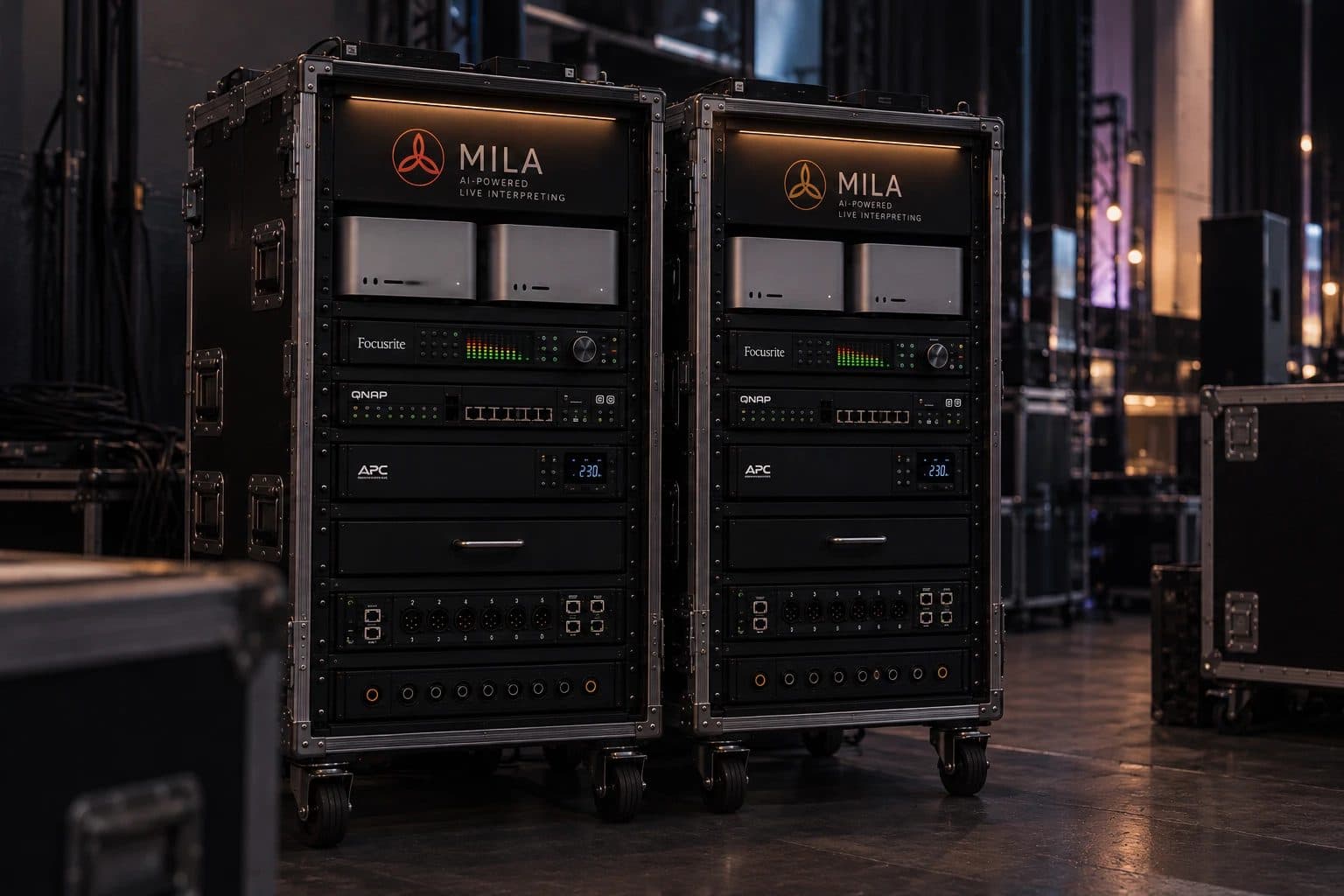
- Plan for on-site support: with MILA, a system technician is always on site. He plans with you, sets up, supports the interpreting during the event and dismantles everything afterwards.
The MILA perspective: reliable in content, not just elegant
At MILA, we do not regard translation quality solely as linguistic elegance. What matters is whether information is conveyed correctly and comprehensibly.
That is why we work on context processing, specialist terminology and methods for quality assessment. Professional AI speech translation must not only sound natural. Above all, it must be reliable in its content.
The question of whether AI understands what it translates in the human sense will be with us for a long time yet. For your event, what counts is what can be planned: careful preparation of the languages, AI simultaneous interpreting that runs locally on our own equipment at the venue, and a system technician who supports it on site. You can find out what this looks like in detail – from the basic flat fee to additional languages – on our Services page. If you are planning a specific event, we would be happy to talk to you about the programme, languages and technology.