Blog · 03/08/2026
Simultaneous interpreting: why 100 languages are not a mark of quality
A hundred languages or more – many AI translation services advertise figures like these. At first glance, this sounds like almost unlimited possibilities: no matter where your guests are travelling from, the right language always seems to be included. Anyone planning simultaneous interpreting for a congress, a specialist conference or a corporate event should nevertheless take a closer look at such figures. After all, the number of languages a service offers says little, initially, about how well it actually renders those languages in the room. In this article, we explain why language pairs vary in difficulty, what role dialects play, how translation quality can be assessed – and what you can look out for when planning.
Impressive figures, difficult comparisons
A long language list is easy to communicate. It fits on any product page and can be compared with other lists. That is precisely the problem: the figure gives the impression that every one of these languages works equally well.
But language translation is not a uniform problem. Translating from German into English places different demands than translating between two languages for which hardly any material is available. And a press release being read aloud is something quite different from a lively panel discussion with a range of accents. Anyone who looks only at the number of languages is therefore comparing apples with oranges.
Languages in simultaneous interpreting: why every language pair is different
What determines the quality of machine translation is not the individual language but the language pair: which source language is being translated into which target language. Two factors play a particularly important role here.
Training data: not every language is equally well represented
The quality of machine translation depends, among other things, on the available training data. For widely spoken languages such as English, German or Spanish, large volumes of digital texts and voice recordings exist. For other languages, considerably less suitable data is available.
This means a language can appear on a list and be technically supported – and yet be based on a much narrower data foundation than the major languages. The list itself will not tell you this.
Linguistic structure and cultural forms of expression
Linguistic structure also plays a role. Differences in grammar, word order and cultural forms of expression can make translation more difficult. The further apart two languages are in these respects, the more a system has to do to convey a thought intelligibly in the target language.
In simultaneous interpreting, there is the added factor that listening and translating happen at the same time. We describe how meaning is also conveyed beyond the words, for example through emphasis and tone of voice, in the article Can AI translate emotions?
Dialects and accents: spoken is not written
Spoken language often differs considerably from standardised written language. At events, people speak freely, interrupt themselves, change sentence structure mid-way or resort to colloquial phrasing.
Dialects, regional accents and colloquial expressions can affect speech recognition – and thus the first step of any AI simultaneous interpreting. A system that reliably processes standard English will not necessarily achieve the same quality with every regional accent.
For your planning, this means the question is not only “Is English supported?” but also “How do our speakers speak?”. Equally important is how the spoken word reaches the system. You can read why a clean microphone signal is the foundation of all recognition in our article AI interpreting and audio technology: why everything starts at the microphone.
How can translation quality be measured?
If the language list reveals little about quality – what does? Research uses a variety of evaluation methods. Automatic metrics, for example, compare machine translations with reference translations.
Such methods are useful for comparing systems with one another systematically. However, they do not capture every aspect of linguistic quality. A translation can resemble a reference in many respects and still miss the mark at a crucial point.
What also counts at live events
At live events in particular, further criteria need to be taken into account:
- Intelligibility: Can guests in the room follow the interpretation?
- Terminology: Are technical terms and proper names rendered correctly?
- Omissions: Are parts of what was said missing from the translation?
- Delays: How large is the time lag between the original and the translation?
These points can only partly be expressed in a single metric. Yet they determine whether a translation holds up within your event programme.
Benchmarks are not your event
A language model can achieve good results in general benchmarks and still struggle at a specific specialist event. The reason lies in the content: general tests rarely reflect exactly the vocabulary used on your stage.
Particular challenges include, for example:
- medical terms at a specialist congress,
- product names at a product launch or a kick-off,
- technical abbreviations at a specialist conference.
That is why professional applications should be tested with realistic content – that is, with the material that will actually come up.
What event organisers can look out for
If you are looking for an interpreter for your event – whether human conference interpreters or an AI interpreter – a few questions can help you look beyond the mere language list. This applies to a specialist conference just as much as to the search for a simultaneous interpreter: congresses, specialist conferences and corporate events each place their own demands on language pairs and vocabulary.
- Which language pairs do you really need? Rather than a long list, what matters is the specific combination of source and target language.
- Who is speaking on your stage? Accents, dialects and unscripted speech affect speech recognition.
- Which technical terms will come up? Medical terms, product names and abbreviations should be known in advance.
- How is quality assessed? Ask your service provider which criteria they use to evaluate the translation – and whether intelligibility, terminology, omissions and delays are taken into account.
- Is there an opportunity for a test under realistic conditions? A rehearsal with real content says more than any general claim.
We look at how AI interpreters and human conference interpreters differ in this respect in the article AI interpreter or human: will the simultaneous interpreter become obsolete?.
The MILA perspective
For us, a long language list is not a sufficient promise of quality. What matters is how reliably a specific language combination performs under realistic conditions. Professional AI interpreting therefore requires transparent quality assessments and careful preparation.
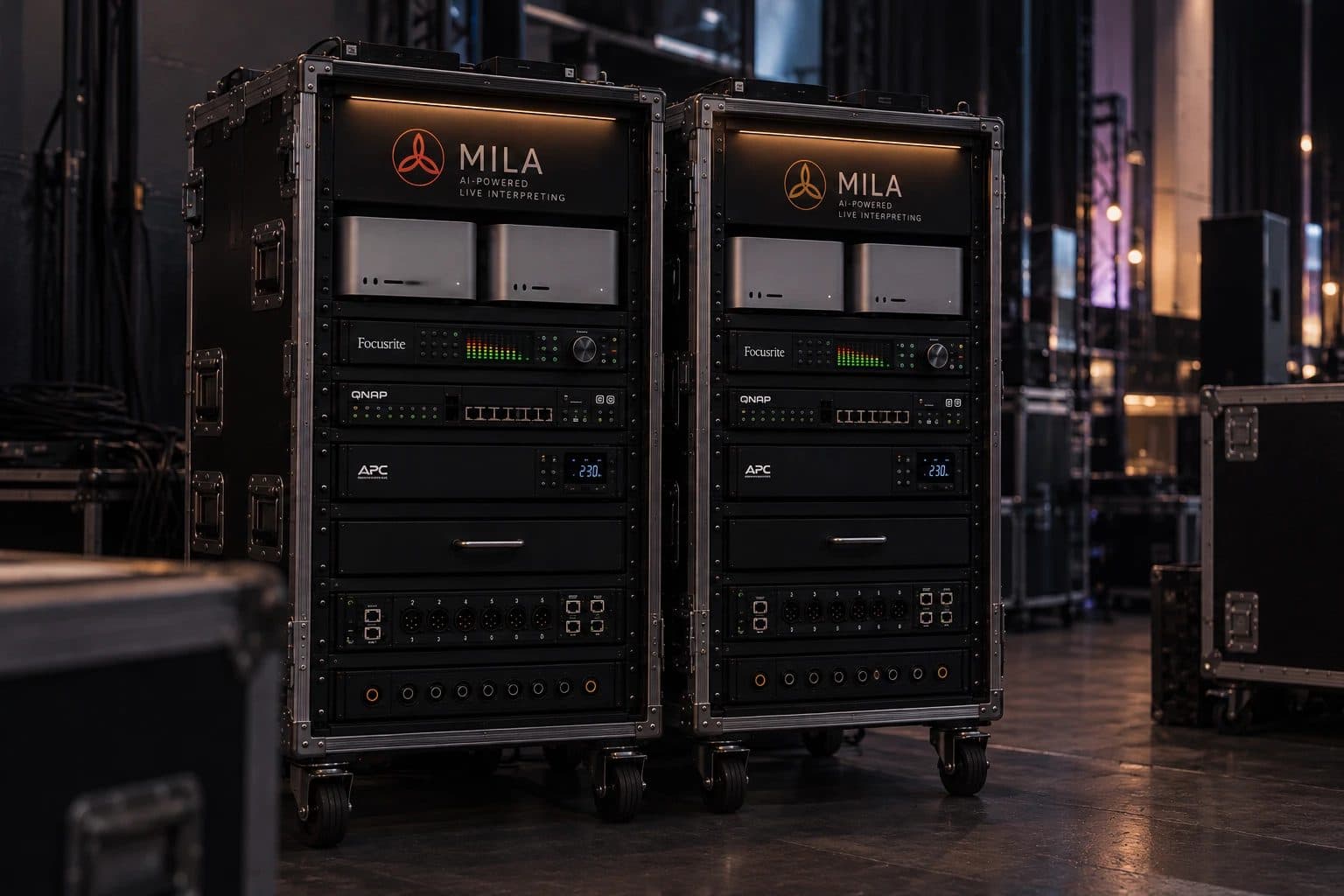
In practice, at MILA this means: German, English, French, Spanish, Italian, Dutch and Polish are available – further languages on request. We set up technical terms and proper names from your programme in advance. The AI simultaneous interpreting runs locally on our own equipment at the venue, without the cloud, and a system technician looks after the interpreting throughout the entire event. On request, we set up the day before and rehearse with you.
If you would like to know which language combination makes sense for your event and what preparation, technology and the process look like, you will find all the details on our Services page. We are also happy to discuss your programme with you directly.